
When parents enroll their children in youth sports, they often assume one thing:
“The coaches have been background checked.”
It sounds reassuring.
But what does that actually mean?
A recent investigation involving the New Orleans Recreation Development Commission (NORD) serves as an important reminder that not all background checks are created equal. According to findings from the New Orleans Office of Inspector General, only about half of volunteer coaches reviewed had current background checks on file. Even more concerning, investigators found the screening process relied heavily on a local criminal records system that did not consistently include offenses committed outside of Orleans Parish. In some cases, coaches with extensive criminal histories were reportedly allowed to participate in youth programs.
The story highlights a critical truth that many organizations, employers, and volunteer programs misunderstand:
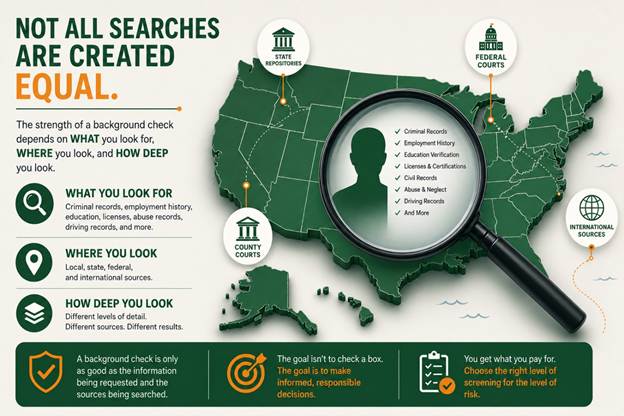
A background check is only as effective as the information being requested and the sources being searched.
The Question Isn’t “Did You Run a Background Check?”
The real question is:
What background check did you run?
There is no universal background check that automatically uncovers everything about a person’s history.
Depending on the position and level of risk involved, organizations may choose to search:
- County criminal records
- State criminal repositories
- Federal criminal records
- National criminal databases
- Sex offender registries
- International criminal records
- Employment history
- Education verification
- Professional licenses
- Motor vehicle records
- Civil court records
- Sanctions and watchlists
- Abuse and neglect registries where available
Each search answers a different question.
A county criminal search may reveal activity in a specific jurisdiction.
A federal search may uncover offenses that would never appear in local courts.
Employment verification confirms whether someone actually worked where they claimed.
Education verification validates degrees and credentials.
The problem arises when organizations assume one search provides a complete picture.
It doesn’t.
Where You Search Matters
The NORD investigation specifically noted that the system being used primarily reflected offenses occurring within Orleans Parish and was limited in its ability to identify crimes from other jurisdictions. Investigators warned that relying solely on such a system can create a false sense of security.
Think about it this way:
If someone lived in five different states over the last ten years, a search limited to one county or one local database may miss significant information elsewhere.
Criminal records in the United States remain highly decentralized. Many records originate at the county level, and reporting practices vary dramatically from one jurisdiction to another.
In other words, where you look can be just as important as what you look for.
Even Criminal Records Aren’t Always Perfect
Another common misconception is that criminal records are comprehensive, complete, and consistent.
Research suggests otherwise.
A 2024 study published in Criminology compared official state criminal history reports with private-sector background checks and found substantial discrepancies between sources. Researchers identified both false positives and false negatives across the reports examined, demonstrating that criminal record data can vary significantly depending on where the information originates and how it is collected.
Additional academic research has documented longstanding concerns regarding the completeness of criminal history records and the reporting of case dispositions across states.
That doesn’t mean background screening isn’t valuable.
It means organizations must understand its limitations and implement screening programs thoughtfully.
The Myth of the National Criminal Database
One of the most common misconceptions in background screening is the belief that there is a single, comprehensive database containing every criminal record in the United States.
There isn’t.
In fact, no government agency maintains a centralized repository of all criminal records from every county, city, state, tribal jurisdiction, and federal court across the country.
That’s because the American criminal justice system is highly fragmented. Criminal records are created and maintained by thousands of individual courts and agencies, each with its own reporting practices, timelines, and standards.
Some jurisdictions report data regularly. Others report inconsistently. Some provide detailed case dispositions. Others provide limited information. In certain areas, records may not be electronically available at all.
This is why many organizations are surprised to learn that a “national criminal database search” is not the same thing as a comprehensive criminal background check.
National databases can be valuable investigative tools. They often aggregate millions of records from numerous jurisdictions and can help identify potential areas that warrant further review. However, they are not complete, and they should not be relied upon as the sole source of criminal history information.
The Professional Background Screening Association (PBSA) and industry best practices recommend using database searches as a supplement to, not a replacement for, direct searches of relevant county, state, and federal records.
Think of a national database as a roadmap.
It can point you toward places that deserve a closer look.
But if you’re making important decisions involving children, vulnerable populations, financial responsibility, healthcare access, or public safety, you’ll eventually need to travel down those roads and verify what is actually there.
Organizations that assume a single database search will uncover everything often discover a hard truth:
When it comes to background screening, there is no “easy button.”
Comprehensive screening requires a thoughtful strategy, multiple data sources, and an understanding of where records are maintained and how they are reported.
The Consumer Reporting Agency Doesn’t Set the Rules
This may be the most misunderstood aspect of background screening.
A Consumer Reporting Agency (CRA), AKA your background screening vendor, does not typically decide what information an employer, volunteer organization, or youth sports league should review.
The organization itself makes those decisions.
The CRA serves as the vehicle for obtaining and reporting information that has been requested and legally authorized.
If an organization requests only a basic search, that is what will be performed.
If it requests a more comprehensive screening package with multiple data sources and verification services, those additional searches can be included.
The effectiveness of the screening program often depends on the organization’s risk assessment, policies, and commitment to due diligence.
Cheap, Fast, Easy: Pick Two
Everyone wants background checks to be:
- Fast
- Comprehensive
- Inexpensive
Unfortunately, those goals often compete with one another.
A low-cost search that relies on limited data sources may provide results quickly, but it may not provide the level of visibility required for higher-risk positions.
A more comprehensive screening program often involves additional jurisdictions, verification efforts, record validation, and manual research, all of which require more time and resources.
Can a basic background check be sufficient in some situations?
Absolutely.
But organizations responsible for children, vulnerable populations, financial assets, healthcare patients, or public safety should carefully evaluate whether a minimal screening program aligns with the level of risk involved.
Trust, But Verify
The lesson from New Orleans is not that background checks don’t work.
The lesson is that background checks are not magic.
They are tools.
Like any tool, their effectiveness depends on how they are used.
When organizations ask the right questions, search the appropriate sources, and align screening practices with the risks of the position, background checks become a powerful component of a broader safety and compliance strategy.
Because when it comes to protecting employees, customers, patients, students, or children, the goal shouldn’t be simply checking a box.
The goal should be conducting meaningful due diligence.
And that starts with understanding that a background check isn’t just a background check.
Sources
- New Orleans Office of Inspector General findings regarding NORD youth coach screenings.
- Lageson, S. & Stewart, R. (2024), The Problem with Criminal Records: Discrepancies Between State Reports and Private-Sector Background Checks, Criminology. Researchers found substantial false-positive and false-negative discrepancies across criminal record sources.
- McElhattan, D. (2022), Punitive Ambiguity: State-Level Criminal Record Data Quality in the Era of Widespread Background Screening, documenting inconsistencies in state criminal record completeness and disposition reporting.